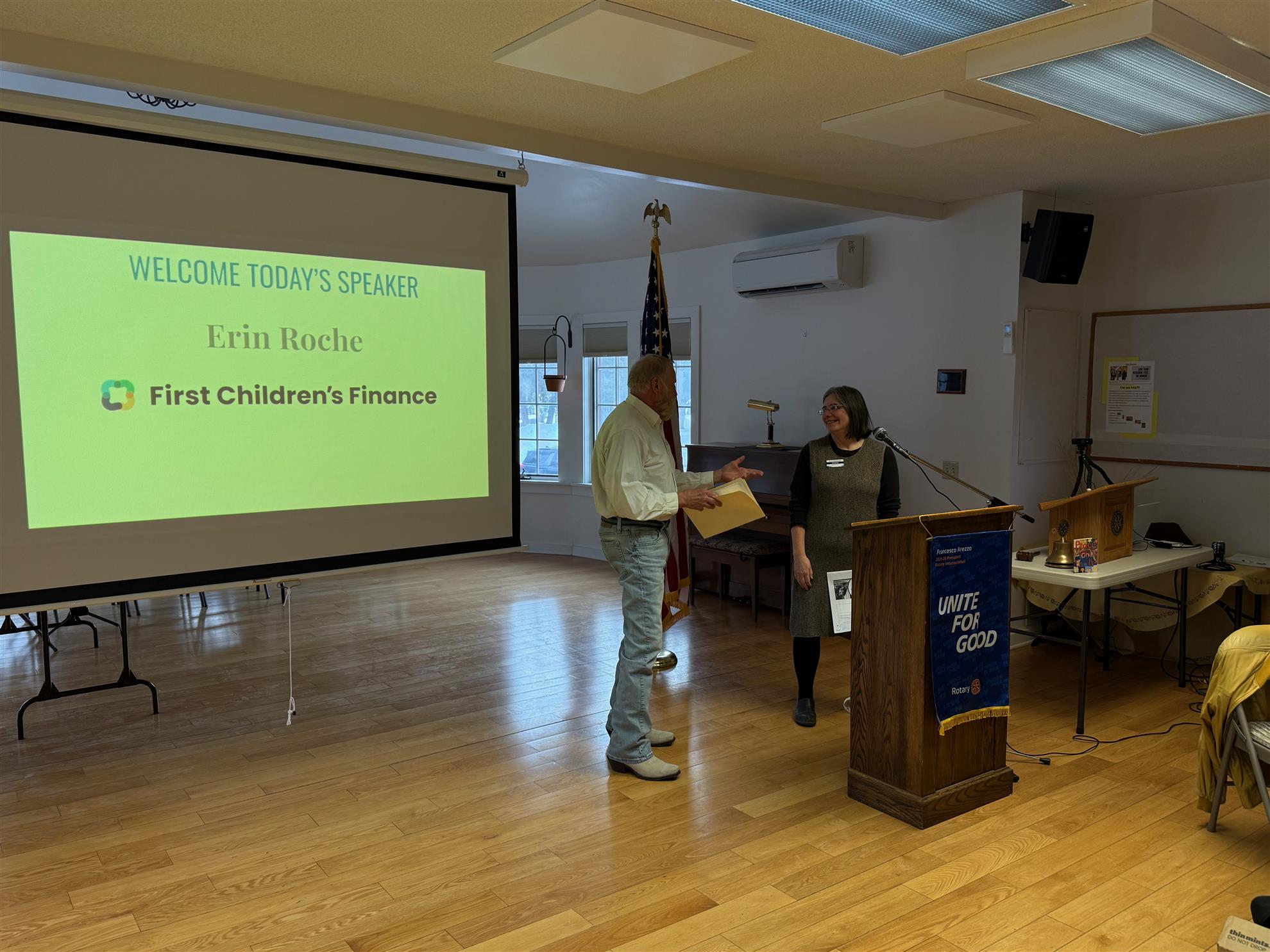
Jim Donovan (left) and
CSH Rotary Club Meeting - February 18, 2026
The Charlotte-Shelburne-Hinesburg Rotary Club gathered for a full and unusually meaningful mid-February meeting, one that balanced the club's own momentum around Pie for Breakfast with a thoughtful youth speech contest and an informative presentation on the state of childcare in Vermont.
The morning opened with the club's annual speech contest, and the students quickly gave the room something worth paying attention to. Patrick Donahue spoke first and, with admirable candor, explained that he had prepared for a slightly different prompt after receiving conflicting information from the school communication chain. Even so, he delivered an earnest and wide-ranging speech on intergenerational understanding, civic life, and what real tolerance requires in a divided culture. Liam Kerr followed with a more polished talk that brought Rotary's values down to the level of everyday school life, arguing that peace begins not in grand diplomatic settings but in classrooms, friendships, honest speech, and the small choices young people make with one another. The judges ultimately selected Liam to advance to the next round on Tuesday, March 10, in Vergennes, but both students left a strong impression. The room clearly appreciated not only the effort involved, but the fact that two local teenagers were willing to stand up early on a winter morning and take the theme seriously.
That sense of momentum carried directly into the latest Pie for Breakfast update. The committee reported that sponsorships were closing in on the club's $15,000 target and that the focus is now shifting from sponsor asks to broad public turnout. Members were encouraged to keep spreading the word through Front Porch Forum, Facebook, posters, and personal invitations so that the event draws a larger crowd than it did last year. The conversation also touched on pie supply, signage, and additional promotion opportunities, but the tone was upbeat: the event is in strong shape, and the work now is about making sure the wider community shows up.
Happy Fines brought the room back into its familiar social rhythm. Members celebrated winter sunshine, Olympic athletes, good speakers, and simple gratitude for being together on a bright Wednesday morning. The recurring blend of humor, local color, and personal updates once again did what Happy Fines does best: remind everyone that fellowship is not an accessory to the meeting but one of its main reasons for being.
The featured presentation came from First Children's Finance, whose Vermont work sits at the intersection of childcare access, economic development, and public policy. The speaker, Erin Roche, offered a clear and timely overview of how Vermont's childcare landscape is changing in the wake of Act 76, the 2023 childcare law. Her core message was pragmatic and encouraging: the state is finally seeing measurable progress, even if the need remains substantial. She explained that the newly published 2026 supply-and-demand analysis shows the childcare gap has narrowed by roughly 2,000 spaces, from more than 10,000 needed spots to about 8,500. For the first time in years, that movement is in the right direction.
Erin also walked members through the mechanics behind that progress. Act 76 increased state support for families, expanded eligibility for assistance, and directed more money into the childcare sector itself. By the end of 2025, Erin said, roughly 50% more children were receiving state childcare assistance than before the law passed. Chittenden County in particular is showing real gains, especially for toddlers and preschoolers, though infant care remains the hardest segment to supply because it is the most labor-intensive and expensive to provide.
The discussion that followed was exactly the kind Rotary tends to generate when the subject is close to both family life and public policy. Members asked about the childcare payroll contribution, the declining number of young children in Vermont, the split between for-profit and nonprofit providers, and the constraints that keep childcare prices from simply rising alongside new subsidies. Erin answered candidly and repeatedly returned to the same basic point: childcare is not a side issue. It is infrastructure. If Vermont wants young families, a functioning workforce, and economically healthy communities, it needs a childcare system that is stable, affordable, and sustainable.
The meeting closed, as it often does, with gratitude for the guests, appreciation for the students, and a reminder that Rotary's work stretches comfortably from local fundraising to public policy to the next generation of civic life. With Liam moving on to the next speech contest round and Pie for Breakfast entering its final stretch, the club left with plenty to look forward to.
The Charlotte-Shelburne-Hinesburg Rotary Club gathered for a full and unusually meaningful mid-February meeting, one that balanced the club's own momentum around Pie for Breakfast with a thoughtful youth speech contest and an informative presentation on the state of childcare in Vermont.
The morning opened with the club's annual speech contest, and the students quickly gave the room something worth paying attention to. Patrick Donahue spoke first and, with admirable candor, explained that he had prepared for a slightly different prompt after receiving conflicting information from the school communication chain. Even so, he delivered an earnest and wide-ranging speech on intergenerational understanding, civic life, and what real tolerance requires in a divided culture. Liam Kerr followed with a more polished talk that brought Rotary's values down to the level of everyday school life, arguing that peace begins not in grand diplomatic settings but in classrooms, friendships, honest speech, and the small choices young people make with one another. The judges ultimately selected Liam to advance to the next round on Tuesday, March 10, in Vergennes, but both students left a strong impression. The room clearly appreciated not only the effort involved, but the fact that two local teenagers were willing to stand up early on a winter morning and take the theme seriously.
That sense of momentum carried directly into the latest Pie for Breakfast update. The committee reported that sponsorships were closing in on the club's $15,000 target and that the focus is now shifting from sponsor asks to broad public turnout. Members were encouraged to keep spreading the word through Front Porch Forum, Facebook, posters, and personal invitations so that the event draws a larger crowd than it did last year. The conversation also touched on pie supply, signage, and additional promotion opportunities, but the tone was upbeat: the event is in strong shape, and the work now is about making sure the wider community shows up.
Happy Fines brought the room back into its familiar social rhythm. Members celebrated winter sunshine, Olympic athletes, good speakers, and simple gratitude for being together on a bright Wednesday morning. The recurring blend of humor, local color, and personal updates once again did what Happy Fines does best: remind everyone that fellowship is not an accessory to the meeting but one of its main reasons for being.
The featured presentation came from First Children's Finance, whose Vermont work sits at the intersection of childcare access, economic development, and public policy. The speaker, Erin Roche, offered a clear and timely overview of how Vermont's childcare landscape is changing in the wake of Act 76, the 2023 childcare law. Her core message was pragmatic and encouraging: the state is finally seeing measurable progress, even if the need remains substantial. She explained that the newly published 2026 supply-and-demand analysis shows the childcare gap has narrowed by roughly 2,000 spaces, from more than 10,000 needed spots to about 8,500. For the first time in years, that movement is in the right direction.
Erin also walked members through the mechanics behind that progress. Act 76 increased state support for families, expanded eligibility for assistance, and directed more money into the childcare sector itself. By the end of 2025, Erin said, roughly 50% more children were receiving state childcare assistance than before the law passed. Chittenden County in particular is showing real gains, especially for toddlers and preschoolers, though infant care remains the hardest segment to supply because it is the most labor-intensive and expensive to provide.
The discussion that followed was exactly the kind Rotary tends to generate when the subject is close to both family life and public policy. Members asked about the childcare payroll contribution, the declining number of young children in Vermont, the split between for-profit and nonprofit providers, and the constraints that keep childcare prices from simply rising alongside new subsidies. Erin answered candidly and repeatedly returned to the same basic point: childcare is not a side issue. It is infrastructure. If Vermont wants young families, a functioning workforce, and economically healthy communities, it needs a childcare system that is stable, affordable, and sustainable.
The meeting closed, as it often does, with gratitude for the guests, appreciation for the students, and a reminder that Rotary's work stretches comfortably from local fundraising to public policy to the next generation of civic life. With Liam moving on to the next speech contest round and Pie for Breakfast entering its final stretch, the club left with plenty to look forward to.