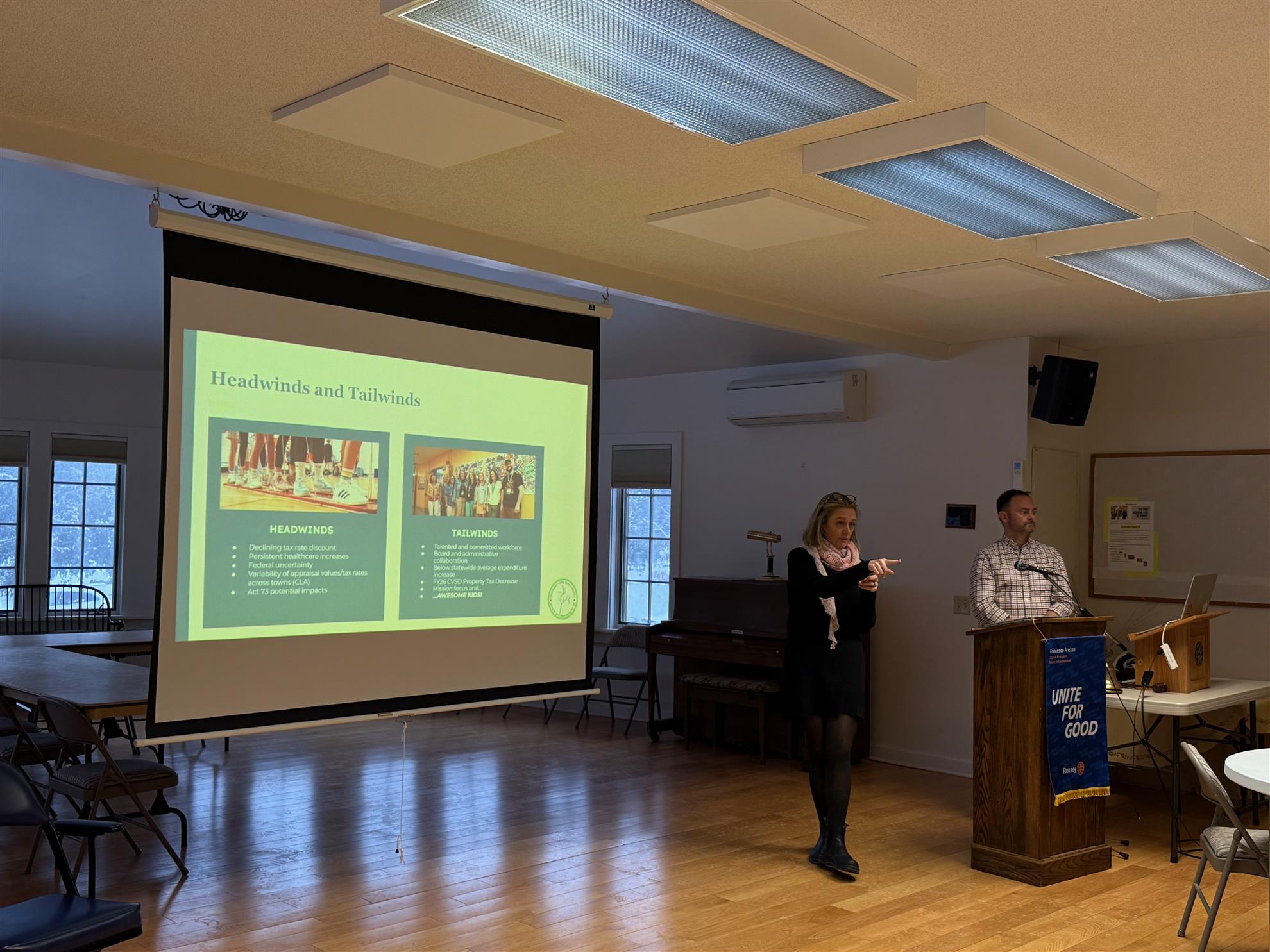
Megan Messler (left) and Gary Marckres (right) present the CVSD budget
CSH Rotary Club Meeting – February 11, 2026
The Charlotte-Shelburne-Hinesburg Rotary Club gathered on a Wednesday morning for a meeting that touched on Olympic curling, Girl Scout Cookies, the final push for Pies for Breakfast—and an unusually substantive conversation about public education finance in Vermont.
Pies for Breakfast: Closing In
Sponsorship totals are now over $10,000, with additional commitments in the pipeline that could bring the number to $12,000 or beyond. The goal remains $15,000, and the event is one month out. A particularly notable development: Joan Lenes secured a $2,500 sponsorship from the Automaster through a personal connection. Joan's networking instincts remain unmatched.
Jessica opened the floor for sponsorship updates. A member reported that she and a colleague canvassed downtown Shelburne businesses and came away with several silent auction contributions from local shops—the country store, the toy shop, the flower shop—and at least one business owner expressed genuine interest in attending a future club meeting. Vermont Tortilla Company also came through with silent auction items. Dave. The energy in the room was tangible: people are getting responses, and the momentum is real.
A few practical reminders from the committee:
- Lead with the full sponsorship ask before pivoting to silent auction donations.
- Keep flyers with you—there are extras in the back.
- Any conversation, anywhere, is a potential opportunity.
- Close to 100 pies have already been pledged through sign-up sheets.
Members were also reminded about a possible opportunity to volunteer at a lasagna fundraising dinner for Pathways Vermont toward the end of March - a low-lift way for the club to be visible in the community. Details to follow.
Happy Fines
The morning's Happy Fines skewed Olympic, civic, and seasonal. A few highlights:
- Ryan Cochrane Siegel, whose parents coached a member's daughter, won a silver medal in curling that very morning. The club raised a glass (of coffee) in his direction.
- Girl Scout Cookies arrive tonight. Catherine who coordinates cookie distribution prepared the room for what can only be described as a logistical undertaking involving forklifts and pallets.
- Dennis Barton just returned from a month in Mexico and contributed a dollar for all "Hardy Vermont Rotarians" who brave winter mornings.
- Another member is nursing a "semi-broken finger" and declined to elaborate beyond a gesture.
- Richard Fox celebrated a successful run of Shelburne Community School's winter musical, noting that three strong performances further vindicate the importance of arts in public education—a theme that would carry into the main presentation.
- Brandon contributed on behalf of the Coast Guard and rescue crews, grateful for the ongoing service of local first responders.
Featured Presentation: CVSD Budget and the State of Education Finance
The morning's featured guests were Megan Messler, Chair of the Champlain Valley School District (CVSD) board, and Gary, the district's Chief Operating Officer. Joan Lenes introduced them warmly. Adam Bunting, the district's superintendent, was unable to attend; he was in Washington, D.C. testifying on behalf of Special Olympics.
Megan opened by noting the particular weight of being a school board member right now—not just the complexity of the work, but the persistence of messaging that Vermont's schools are failing. She pushed back on that directly and with data. CVSD's graduation rate is 96% (state average: 82%). A six-year graduation rate reaches 97%, accounting for students in special education who appropriately take longer. 87% of students scored proficient or above on standardized literacy tests. 70% of students go on to college, compared to a state average of 45%. The district's attendance rate is 94%.
Megan was candid that these numbers involve some selection - every presenter cherry-picks - but the underlying picture, she argued, is one of a district that is genuinely working. The board's broader focus has shifted to what they call "student story": the idea that academic performance follows only when students feel they belong. Metrics support this too: 96% of students say they have friends who treat them with kindness and respect; 94% have at least one trusted adult at school; 91% feel prepared for life after high school.
The Budget
The proposed FY26 budget is $107.9 million, a 5% increase over last year. That number reflects a 5.5% increase in teacher salaries and a 7% increase in health care costs—costs the district does not control. When the administration first brought a number to the board, it was $109 million. The board sent them back to sharpen the pencil. They did, and landed at $107.9 million, which Megan described as a "level-ish service budget": no cuts to programming, maintaining what currently exists.
Gary walked through the cost-per-weighted-pupil figure, which is the metric he focuses on as his own internal report card. Despite declining enrollment (actual students down about 100), the weighted pupil count is slightly up because of demographic shifts—more students qualifying for enhanced funding weights (English Language Learners at 2.49x, economically disadvantaged at 1.03x). The net-net spending per weighted student is projected to increase by 2.7%, compared to a statewide forecast of 6-6.5%.
The district has also made significant cuts in recent years: 82 full-time equivalent positions removed, and $4 million cut last year after the FY25 budget faced community pressure. This year's budget is the board's attempt to hold the line—to not continue cutting—while managing the external cost pressures they cannot avoid.
The Tax Rate Problem
The part that complicates an otherwise responsible budget: the Common Level of Appraisal (CLA), which adjusts each town's education tax rate based on the gap between assessed property values and recent sale prices. In towns like Shelburne, which have not been reappraised recently, that gap has grown significantly—and the resulting CLA adjustment can translate a modest budget increase into a substantial tax bill increase for homeowners. Gary noted that last year, a projected 5.8% average tax increase across the five towns actually resulted in a 4% decrease when bills came out—a nearly 10-point swing.
The governor, the House, and the Senate have all indicated they expect to buy down tax rates again, but that won't be finalized until May or June—well after Town Meeting Day. The district is required to present the numbers it knows today, even knowing they will change.
Act 73 and the Road Ahead
Much of the Q&A turned to Act 73, the governor's school transformation plan. Its two main components: first, a major consolidation of Vermont's 119 school districts (the governor's original proposal was five districts statewide; a map introduced the day before the meeting by the chair of House Education proposed 28, with CVSD remaining intact as its own district); second, a shift to a "foundation formula" for funding, which would replace local budget votes with a statewide per-pupil allocation.
Megan and Gary expressed support for the general direction of consolidation—Vermont's 51 superintendents for 80,000 students is genuinely inefficient—while noting that CVSD already consolidated from five separate districts in 2017, and has achieved real efficiencies of scale. There is less low-hanging fruit for a district that already operates at scale. Class sizes average 20 in K-8 and 21 at the high school, both well above proposed minimums.
Several members asked probing questions. One raised the connection between rising assessed values and education tax rates, and the feedback loop that creates for housing affordability. Gary acknowledged it's nearly impossible to separate education finance, housing costs, and Vermont's demographic challenges—they are all bound together.
In appreciation, Jim Donovan presented the guests with a book to be donated to the Carpenter-Carse Library in Hinesburg. The presentation was substantive and generated more Q&A than most; members lingered on the topic well past the formal presentation.
Looking Ahead
- February 18: Speech Contest at the regular club meeting
- March 10: District-level Speech Contest (open to members who wish to attend)
- March 14: Pies for Breakfast — Pi Day. Keep the outreach going.
- Next week: Age Well speaker Tracy at the regular Wednesday meeting
The CSH Rotary Club meets Wednesday mornings at the Episcopal Church in Shelburne. If you have a sponsor lead, now is the time.