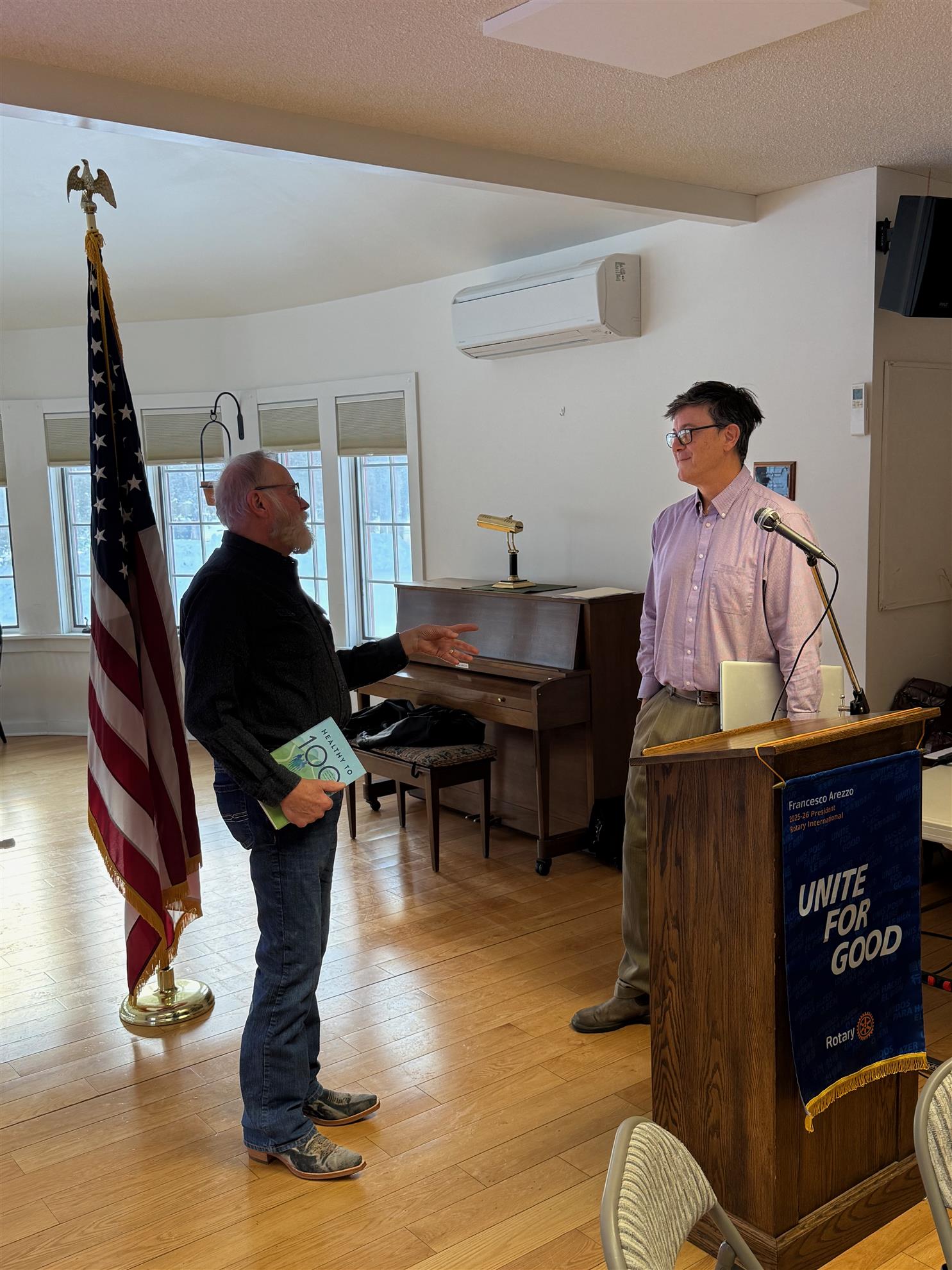
Jim Donovan (left) and Jason Farrell (right)
CSH Rotary Club Meeting - February 25, 2026
The Charlotte-Shelburne-Hinesburg Rotary Club gathered for a meeting that felt both practical and generous in spirit, moving from recognition and club business into the final operational push for Pie for Breakfast before settling into a substantial presentation from Age Well on what it takes to support older Vermonters well.
The morning opened with recognition for Dr. John Pane, who received a Paul Harris honor in acknowledgment of his contributions. As always, the moment served not just as a personal recognition but as a quiet reminder of how much giving happens inside the club, often without much fanfare. From there, Catherine brought members up to speed on the speech contest. The club's winner will advance to the next round on March 10 at the Strong House Inn in Vergennes, and the club is still lining up both attendees and a judge for that event. Members were also reminded that the board decided to give the runner-up a modest award this year, a small but meaningful way to recognize the effort it takes for students to show up and speak.
The biggest block of club business centered on Pie for Breakfast, and the update was encouraging. The club is now essentially at its sponsorship target, with totals approaching $15,000 even before ticket and raffle revenue is counted. That shift means the work is now less about chasing major sponsor dollars and more about execution: getting people through the door, lining up volunteers, securing a few more silent auction and raffle items, and tightening the event-day plan.
Members heard that pies will come from several familiar local sources, along with home bakers inside the club. A volunteer sign-up is now in circulation for the event itself, including help with raffle ticket sales, general event logistics, and a particularly important Friday task: picking up pies and holding them overnight for Saturday morning. There was also discussion of adding the volunteer link to the club website and continuing to build out the raffle table. One member reported a strong local response from businesses that may not be writing checks but are willing to contribute books, gift cards, and other silent auction items. The overall message was clear: the fundraiser is in very good shape, but a well-run final stretch still matters.
The club also put one lingering internal issue to rest, at least for now, by clarifying breakfast contributions. The new expectation is simple and public: $5 for breakfast and $1 for the raffle, for a total of $6. That decision brings a little more structure to a topic the board has been wrestling with for weeks and gives members a straightforward number to work with going forward.
Brandon also previewed the upcoming member survey, which is designed to gather more useful background information on club members, including interests, experience, and potential areas for involvement. The survey will be distributed by email, and the club is considering a small incentive to encourage participation. It was presented not as busywork, but as a practical way to better understand the capabilities already in the room.
Happy Fines then did what they usually do best: turned the meeting from business into fellowship. Members shared updates about travel, surgery recovery, home renovations, pregnancy, youth sports, Vermont weather, and the comic relief of a snowstorm that never quite materialized. Relief at not digging out from a major blizzard sat side by side with mock disappointment from the winter purists who wished the storm had delivered. A few of the updates were especially warm: members welcomed one another back after absences, celebrated family milestones, and nodded to the kind of ordinary good fortune that tends to surface in this part of the meeting.
The featured speaker was Jason Farrell of Age Well, whose remarks gave the club a fuller picture of the organization beyond its best-known public face, Meals on Wheels. Farrell brought both professional clarity and personal connection to the topic, grounding his remarks in his own Vermont ties before explaining the scale of Age Well's work across Addison, Chittenden, Franklin, and Grand Isle counties. Meals on Wheels remains central, but he emphasized that it is only part of the story. Age Well also provides case management, Medicare support, social service coordination, congregate meals, volunteer programs, and access to durable medical equipment for community members who need it.
Farrell's main point was that aging services in Vermont are not getting less important. They are getting more important, quickly. Vermont remains one of the oldest states in the country, and the need for nutrition, social support, and practical aging-in-place services continues to grow. Meals on Wheels itself, he noted, is about more than food. It is also a regular safety check, a touchpoint for isolated residents, and often an entryway into broader support. Age Well currently delivers that work with no paid meal drivers, relying instead on a large and committed volunteer network.
He also used the visit to frame the organization's March for Meals campaign, which is building toward its annual fashion-show fundraiser. The campaign is meant to do several things at once: raise money, recruit volunteers, increase visibility, and remind communities that these services are not abstract. They are the kind of supports that allow older Vermonters to stay safe, fed, and connected. When members asked about scale, Farrell explained that Meals on Wheels represents only about a third of Age Well's work; much of the rest lies in the less visible but deeply important social-service side of the organization.
The Q&A that followed brought out just how practical the club's interest was. Members asked about what recipients pay, how durable medical equipment is collected and redistributed, whether federal funding cuts have hit the organization, and how large the Age Well workforce has become. Farrell's answers were detailed and grounded. People are served regardless of ability to pay. Equipment is donated by the community and recirculated for free. The organization has grown significantly in both scope and staff, and its leaders are working hard to preserve the quality and culture that make that growth sustainable.
By the end of the meeting, the through-line was easy to see. Rotary is heading into the home stretch of its own major fundraiser just as it hears from another community organization about the slow, daily work of meeting real needs. It made for a fitting late-February gathering: practical, local, and very much about showing up for the people around us.
The Charlotte-Shelburne-Hinesburg Rotary Club gathered for a meeting that felt both practical and generous in spirit, moving from recognition and club business into the final operational push for Pie for Breakfast before settling into a substantial presentation from Age Well on what it takes to support older Vermonters well.
The morning opened with recognition for Dr. John Pane, who received a Paul Harris honor in acknowledgment of his contributions. As always, the moment served not just as a personal recognition but as a quiet reminder of how much giving happens inside the club, often without much fanfare. From there, Catherine brought members up to speed on the speech contest. The club's winner will advance to the next round on March 10 at the Strong House Inn in Vergennes, and the club is still lining up both attendees and a judge for that event. Members were also reminded that the board decided to give the runner-up a modest award this year, a small but meaningful way to recognize the effort it takes for students to show up and speak.
The biggest block of club business centered on Pie for Breakfast, and the update was encouraging. The club is now essentially at its sponsorship target, with totals approaching $15,000 even before ticket and raffle revenue is counted. That shift means the work is now less about chasing major sponsor dollars and more about execution: getting people through the door, lining up volunteers, securing a few more silent auction and raffle items, and tightening the event-day plan.
Members heard that pies will come from several familiar local sources, along with home bakers inside the club. A volunteer sign-up is now in circulation for the event itself, including help with raffle ticket sales, general event logistics, and a particularly important Friday task: picking up pies and holding them overnight for Saturday morning. There was also discussion of adding the volunteer link to the club website and continuing to build out the raffle table. One member reported a strong local response from businesses that may not be writing checks but are willing to contribute books, gift cards, and other silent auction items. The overall message was clear: the fundraiser is in very good shape, but a well-run final stretch still matters.
The club also put one lingering internal issue to rest, at least for now, by clarifying breakfast contributions. The new expectation is simple and public: $5 for breakfast and $1 for the raffle, for a total of $6. That decision brings a little more structure to a topic the board has been wrestling with for weeks and gives members a straightforward number to work with going forward.
Brandon also previewed the upcoming member survey, which is designed to gather more useful background information on club members, including interests, experience, and potential areas for involvement. The survey will be distributed by email, and the club is considering a small incentive to encourage participation. It was presented not as busywork, but as a practical way to better understand the capabilities already in the room.
Happy Fines then did what they usually do best: turned the meeting from business into fellowship. Members shared updates about travel, surgery recovery, home renovations, pregnancy, youth sports, Vermont weather, and the comic relief of a snowstorm that never quite materialized. Relief at not digging out from a major blizzard sat side by side with mock disappointment from the winter purists who wished the storm had delivered. A few of the updates were especially warm: members welcomed one another back after absences, celebrated family milestones, and nodded to the kind of ordinary good fortune that tends to surface in this part of the meeting.
The featured speaker was Jason Farrell of Age Well, whose remarks gave the club a fuller picture of the organization beyond its best-known public face, Meals on Wheels. Farrell brought both professional clarity and personal connection to the topic, grounding his remarks in his own Vermont ties before explaining the scale of Age Well's work across Addison, Chittenden, Franklin, and Grand Isle counties. Meals on Wheels remains central, but he emphasized that it is only part of the story. Age Well also provides case management, Medicare support, social service coordination, congregate meals, volunteer programs, and access to durable medical equipment for community members who need it.
Farrell's main point was that aging services in Vermont are not getting less important. They are getting more important, quickly. Vermont remains one of the oldest states in the country, and the need for nutrition, social support, and practical aging-in-place services continues to grow. Meals on Wheels itself, he noted, is about more than food. It is also a regular safety check, a touchpoint for isolated residents, and often an entryway into broader support. Age Well currently delivers that work with no paid meal drivers, relying instead on a large and committed volunteer network.
He also used the visit to frame the organization's March for Meals campaign, which is building toward its annual fashion-show fundraiser. The campaign is meant to do several things at once: raise money, recruit volunteers, increase visibility, and remind communities that these services are not abstract. They are the kind of supports that allow older Vermonters to stay safe, fed, and connected. When members asked about scale, Farrell explained that Meals on Wheels represents only about a third of Age Well's work; much of the rest lies in the less visible but deeply important social-service side of the organization.
The Q&A that followed brought out just how practical the club's interest was. Members asked about what recipients pay, how durable medical equipment is collected and redistributed, whether federal funding cuts have hit the organization, and how large the Age Well workforce has become. Farrell's answers were detailed and grounded. People are served regardless of ability to pay. Equipment is donated by the community and recirculated for free. The organization has grown significantly in both scope and staff, and its leaders are working hard to preserve the quality and culture that make that growth sustainable.
By the end of the meeting, the through-line was easy to see. Rotary is heading into the home stretch of its own major fundraiser just as it hears from another community organization about the slow, daily work of meeting real needs. It made for a fitting late-February gathering: practical, local, and very much about showing up for the people around us.