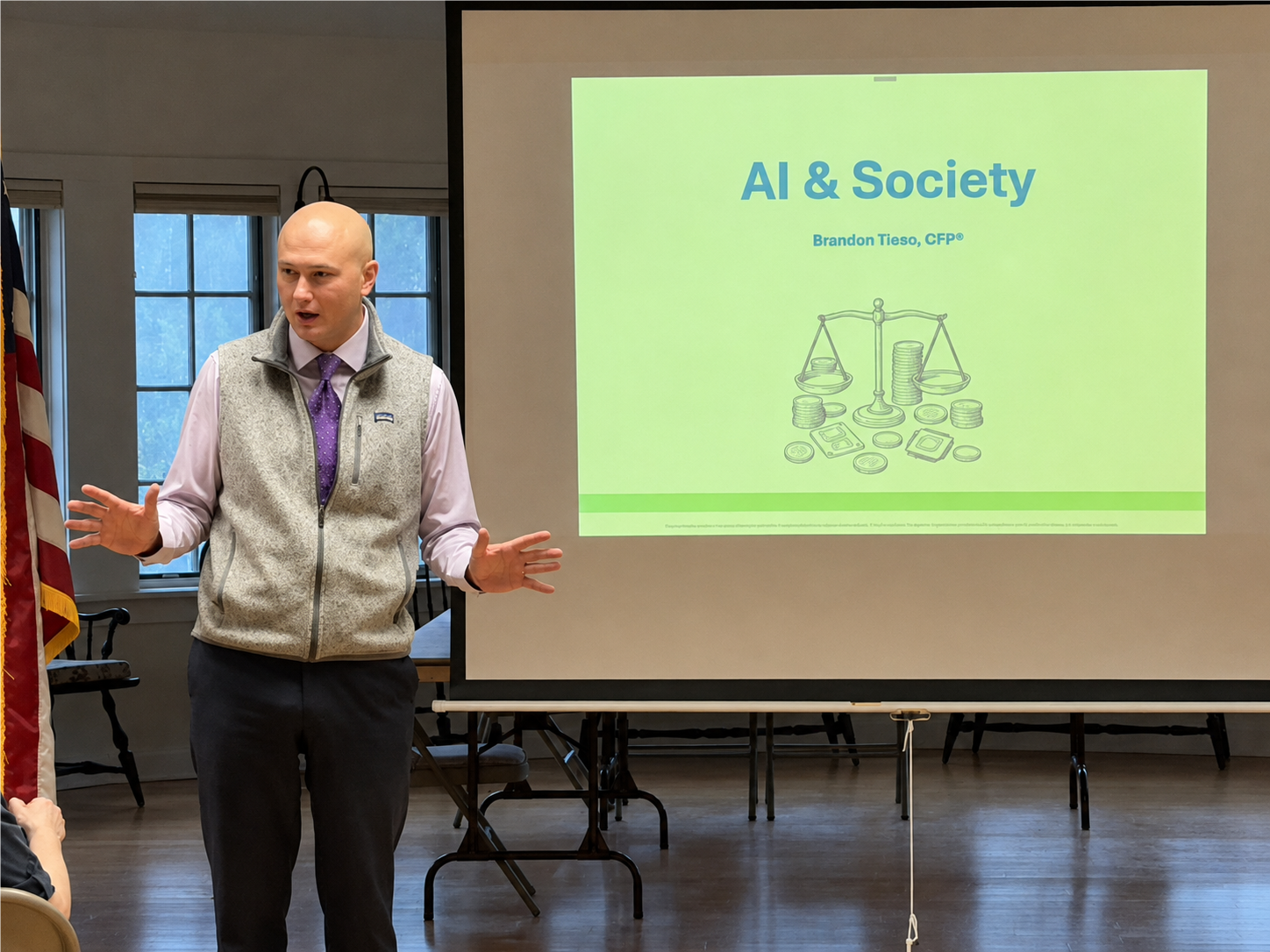
Brandon Tieso (left) led a wide-ranging discussion on artificial intelligence, work, media, judgment, and the importance of preserving human connection during the May 27 Rotary meeting.
The Charlotte-Shelburne-Hinesburg Rotary Club opened its May 27 meeting with a reflection from How to Be More Tree, using the sugar maple as a reminder to look out for the next generation and help those still growing in the shade.
Club business moved quickly so members could leave extra time for the featured speaker. Updates included the final stretch of Snack Shack season, name badge requests, the end-of-June potluck, the spelling bee, RYLA planning, and continued support for the local food shelves. Members also heard a note of thanks from the Shelburne Food Shelf for the club’s holiday donation, and were reminded that the club will not hold its regular meeting next week because of Phil’s memorial service.
Happy Fines brought the usual mix of fellowship, gratitude, travel notes, family milestones, Snack Shack stories, and memories of Phil. Members shared updates from Dragon Heart Vermont practice, birthday celebrations, graduations, garden progress, family visits, and the volunteers who have kept showing up during a busy Snack Shack week.
The featured program was a presentation by Brandon on artificial intelligence and what it may mean for work, media, education, and community life. Brandon began by distinguishing today’s generative AI from earlier forms of artificial intelligence. AI has existed for decades, but the current wave is different because it is consumer-facing, widely available, and moving across society much faster than past technological revolutions. Where earlier changes such as mechanization, electricity, and computing unfolded over generations, AI is being deployed through tools and networks that already exist.
Brandon framed AI as a double-edged technology. He emphasized that it has real benefits and is already capable of helping people produce, analyze, design, and organize work at a high level. At the same time, he warned that the speed and scale of the change could be disruptive, especially for people whose work depends heavily on computer-based cognitive tasks. His core point was not that all human expertise disappears, but that many forms of routine intellectual labor may face new competition from machines that can now produce competent work quickly and cheaply.
To make the issue concrete, Brandon demonstrated how AI can help create a polished presentation from spoken ideas, turning a rough voice memo into organized slides in minutes. He used that example to show how AI can help people materialize ideas quickly, while also raising the question of what happens to jobs and training paths when entry-level work can be automated or compressed.
The discussion then moved into art, media, and public trust. Brandon showed examples of AI-generated images in the style of famous artists, historical photo colorization, and realistic video and audio generation. These examples illustrated both the promise and the risk of the technology. AI can make old images more vivid and help people imagine the past, but it can also blur the line between reconstruction and invention. The club discussion touched on the importance of accuracy, context, and judgment, especially when AI is used in fields such as law, medicine, education, history, and public communication.
Several members raised thoughtful questions about whether AI accelerates a broader “race to the bottom” by making “good enough” work easier to accept. Brandon agreed that the risk is real, particularly when people use AI without taste, standards, or subject-matter judgment. He contrasted that with uses where AI works best as a partner to human expertise, such as in medical imaging, where a trained professional may use AI to help identify patterns while still exercising human judgment.
The final portion of the talk returned to community. Brandon argued that as technology makes more parts of life efficient, remote, and automated, people will need to be more intentional about preserving the inefficient but deeply human parts of life: reading deeply, meeting in person, volunteering, attending town meeting, sharing meals, talking without screens, and belonging to local institutions. In that sense, Rotary itself was part of the answer. The club is a place where people still show up, listen, laugh, serve, disagree respectfully, and see one another as neighbors rather than abstractions.
The meeting closed with a reminder to slow down and enjoy the day, and with appreciation for everyone who continues to show up for the club’s work in the community.